
Posted by Tara Manthey on September 3rd 2008
Preventing child obesity requires focus on overall health and fitness
Schools and communities should move beyond BMI and vending machines to promote health
LITTLE ROCK - Arkansas schools and communities focus too often on the problem of obesity and miss opportunities to inspire children to live a healthy lifestyle, according to a new report from Arkansas Advocates for Children and Families.
A statewide survey of school and community programs found that the most effective did more than weigh children and stock vending machines with healthier snacks.
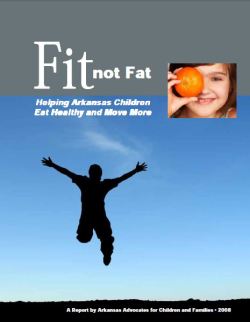
"Fit Not Fat: Helping Arkansas Children Eat Healthy and Move More," and an accompanying website, www.changingchildobesity.org, show how some schools and communities are promoting overall health with outstanding programs. The report recommends that these programs be shared around the state to help other communities adopt effective programs and adapt them to fit their needs.
"Many people we talked to said that the sole focus on 'obesity' does not inspire children or schools to change, because of its negative connotations," said Elisabeth Wright Burak, Health Policy Director at AACF. "Around the state, we need to focus on overall health and fitness if we want to inspire success."
In Batesville, students at the Eagle Mountain Magnet School can participate in yoga, biking and dancing during and after school. Schools in Rogers link fitness and academics with evidence-based programs. And in Wilburn, a county extension service agent not only tells students about healthier foods, the agent prepares recipes for students to taste and sends them home with copies.
The state's child anti-obesity law, Act 1220 of 2003, mandated ground-breaking policies that have helped stop the rate of increase of childhood obesity in the state. But "Fit Not Fat" indicates that more must be done if we want our children grow into healthy adults.
The study researched innovative programs that schools and communities have created that reach beyond the mandates.
"We sent out surveys, interviewed teachers, coaches and experts. We held focus groups and analyzed curricula and demographic data to tell the story of these community efforts," Burak said.
The report distills the information into several lessons and offers these recommendations for policymakers and foundations, including:
- Revisit the role and priorities of the Child Health Advisory Committee.
- Strengthen relationships among wellness committees, wellness priorities and Coordinated School Health.
- Expand Coordinated School Health to offer additional support to schools.
- Invest in quality physical education. Many state-level efforts have concentrated on eating behavior and screening or measurement.
- Use opportunities outside the school day to promote wellness.
Information in the report and website was researched for AACF by Sandra Miller. The report was written by Miller and Elisabeth Wright Burak of AACF. The work was made possible in part from a grant by the Blue & You Foundation for a Healthier Arkansas and Arkansas Children's Hospital.

